What Happened to the Settlement on Roanoke Island?
In 1585, the English settlers reached the New World and established a colony on the island of Roanoke, in what is now part of North Carolina, just to mysteriously disappear. The colonists' fate has become one of American history'due south most indelible mysteries, and now archaeologists have uncovered new prove suggesting that the survivors splintered into multiple camps and alloyed into the Ethnic population.
Thanks to a surreptitious message on a centuries-old map, a team from the First Colony Foundation, a N Carolina nonprofit defended to researching the history of the ill-blighted Walter Raleigh colony, was able to uncover colonial-era pottery they believe belonged to some of the 115 men, women, and children abandoned on Roanoke in 1587.
When the colony'due south governor, John White, returned from a three-year journey back to England in 1590, all traces of the settlement and its inhabitants had disappeared. The only clue left behind was the word "Croatoan," the former name of what is now Hatteras Island, carved into a post.
There are many theories about what became of Roanoke, none of which are specially pleasant. Historians have posited that the colonists were killed by Native Americans or hostile Spaniards, or that they died off due to disease or famine, or were victims of a deadly storm.
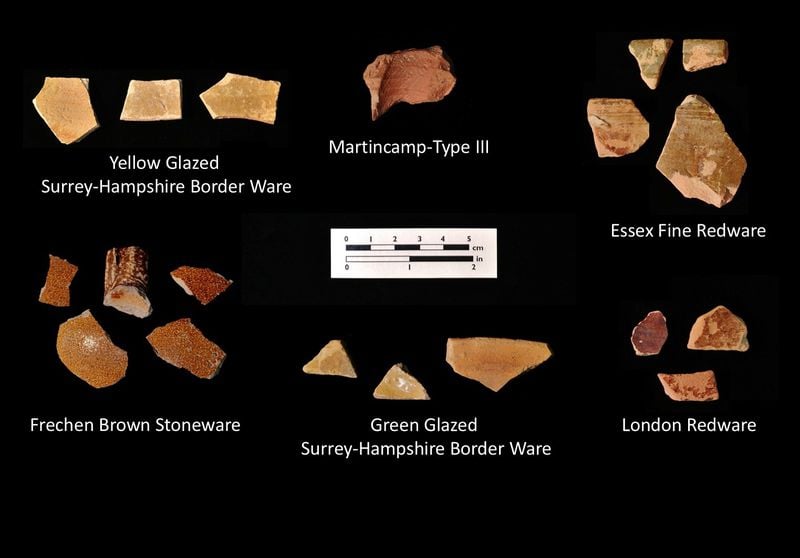
Fragments of early on English pottery were found by archaeologists with the First Colony Foundation. The leading theory is that they belonged to survivors of the lost Roanoke colony. Photo courtesy of the First Colony Foundation.
But researchers uncovered a new lead in 2012 while examining a map at the British Museum in London that White had painted of the Elizabethan-era United States, titled La Virginea Pars. Subconscious in invisible ink, presumably to guard information about the colonies from the Castilian, were the outlines of two forts, one 50 miles westward of Roanoke—the same distance away that the colonists had told White they planned to motility, according to his writings.
The Offset Colony Foundation'south squad of archaeologists, led by Nick Luccketti, gear up out to investigate the site in Bertie Canton, North Carolina, in 2015. Promisingly, the possible settlement was shut to a Native American hamlet called Mettaquem, typical of early European settlements.
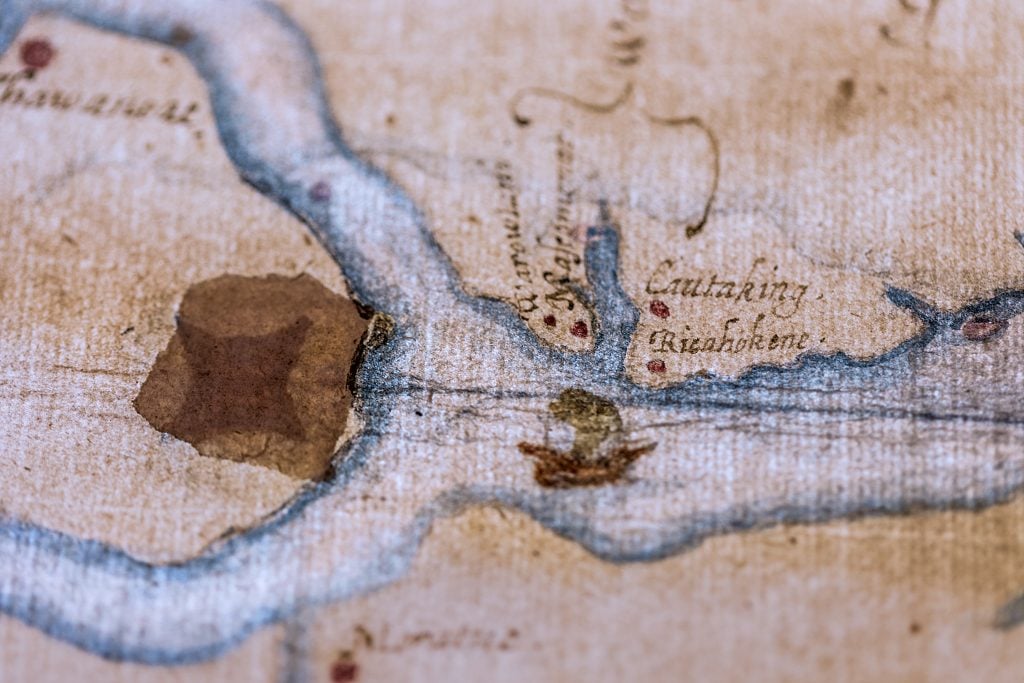
This 16th-century map of what is now coastal North Carolina appears to show a fort concealed under a patch and visible only past backlighting that may accept been where survivors settled later abandoning Roanoke Island. Photograph by Stuart Conway, courtesy of the trustees of the British Museum.
There was no sign of a fort, but just outside the hamlet wall the archaeologists found two dozen shards of English pottery at what'southward been dubbed Site 10. Ground-penetrating radar revealed another possible dig site two miles abroad.
The search continued in December 2019 at what's been dubbed Site Y, yielding many more fragments of ceramics from different parts of Europe. The fragments, which come up from vessels used for food preparation and storage, suggest the presence of long-term residents.
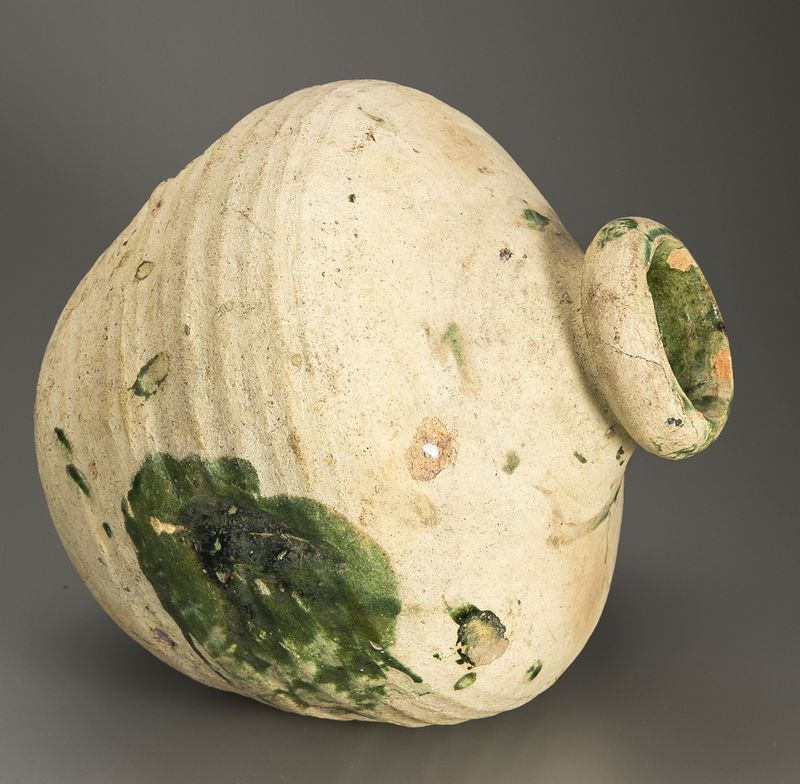
This Spanish olive jar is from Jamestown. Archaeologists with the First Colony Foundation uncovered in Bertie County fragments of a similar slice that may have belonged to members of the Roanoke colony. Photo courtesy of the First Colony Foundation.
"What has been plant so far at Site Y in Bertie County appears to me to solve 1 of the greatest mysteries in Early American history, the odyssey of the 'Lost' colony," William Thousand. Kelso, emeritus director of archaeology and research at Jamestown Rediscovery, said in a statement.
Although the experts oasis't ruled out the possibility that the artifacts may accept been left behind by colonists from Jamestown, founded in 1607, Luccketti is confident that his observe is show of a group of relocated Roanoke colonists. Notable is a lack of English language pipes, which were ubiquitous among Jamestown settlers, suggesting the ceramics date from an before period.
"We are very confident that these excavations are linked to the Roanoke colonies. We take considered all other reasonable possibilities and can find nothing else that fits the evidence," a Starting time Colony Foundation representative told Artnet News in an email. "[The excavations] begin to reveal where the colonist went to live and how they tried to survive in the New World."
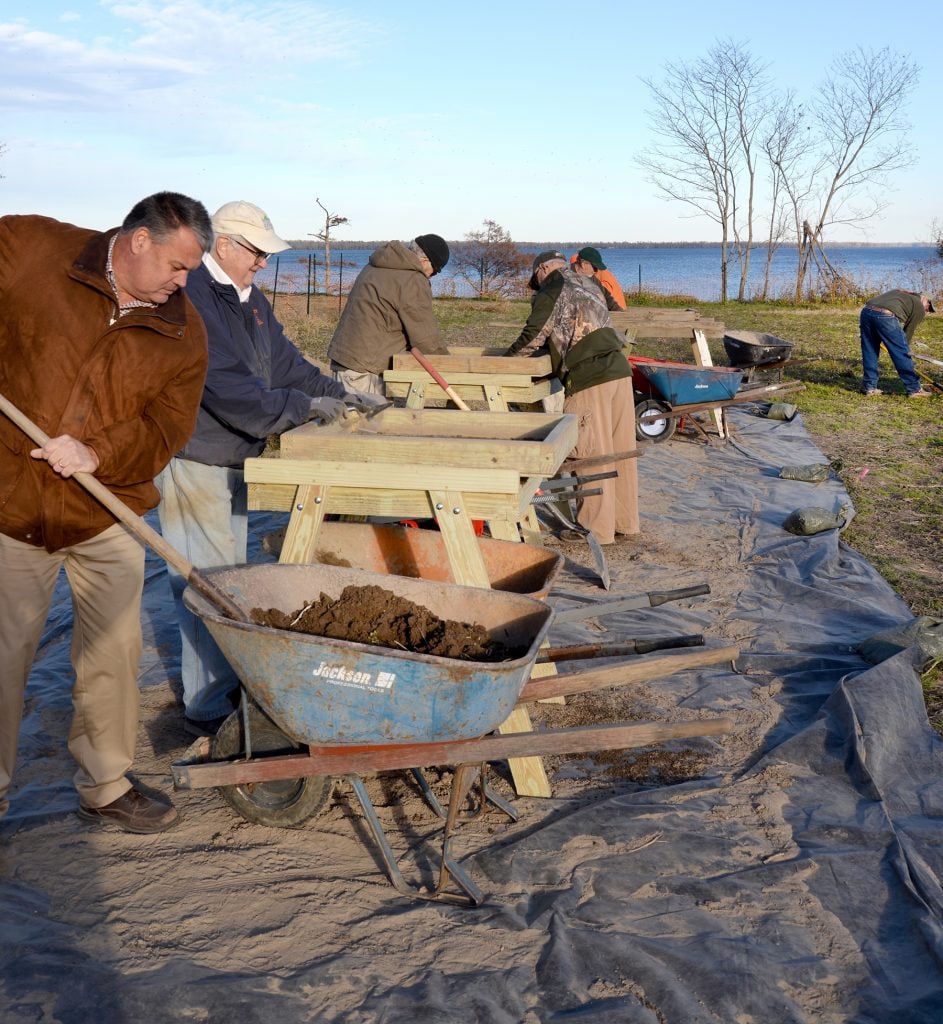
The First Colony Foundation during excavations at Site Y, at present believed to be settled past the lost Roanoke survivors. Photo courtesy of the First Colony Foundation.
But not everyone is ownership this explanation for the colony's ultimate fate. "I am skeptical," says Charles Ewen, an archeologist at Due east Carolina University, told National Geographic. "They are looking to prove rather than seeking to disprove their theory, which is the scientific mode."
Another theory about the colony is that the settlers moved to Croatoan—hence the apparently not-and so cryptic note. "Bertie was the heart of enemy territory," Scott Dawson, cofounder of the Croatoan Archaeological Society, told the Virginian-Pilot. "It is the last identify they would go. The colony literally wrote downwards they relocated to Croatoan."
Before this year, Dawson published a volume, The Lost Colony and Hatteras Island, detailing the findings of the club'south 10 years of excavations at Hatteras Island led by Marker Horton, an archaeologist at the University of Bristol, in England.
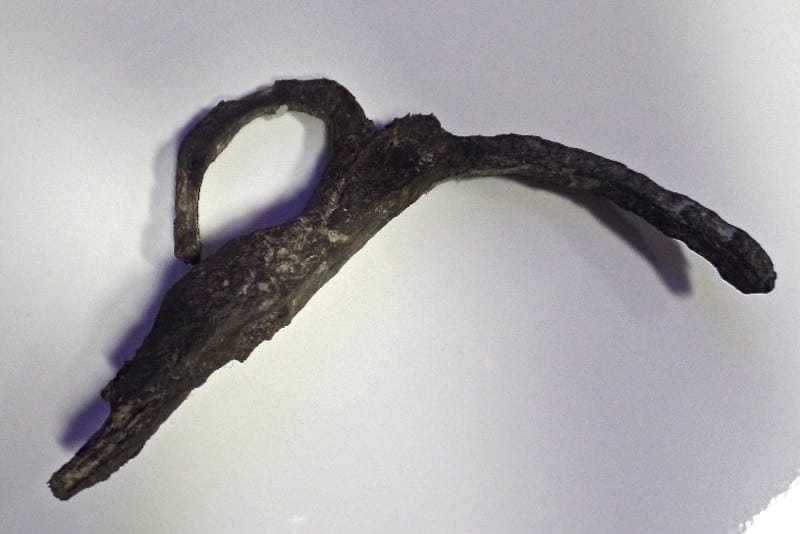
A partial handle of an Elizabethan rapier plant on Hatteras Isle. Croatoan Archeological Lodge.
"Basically, the historical testify says [Hatteras is] where they went," Horton told the New York Times in September. He is preparing a peer-reviewed study presenting his findings on the island, which include a rapier hilt, late 16th-century gun hardware, and a slate writing tablet fragment.
Of course, both recent archaeologist finds could be evidence of the Roanoke's fate.
"Peradventure," said Jamestown Rediscovery President and Kickoff Colony board fellow member James Horn in a argument, "a small grouping went to Croatoan Island in the fall or winter of 1587 to wait for John White to return, while the remainder moved inland."
Follow Artnet News on Facebook:
Desire to stay ahead of the art world? Subscribe to our newsletter to get the breaking news, eye-opening interviews, and incisive critical takes that bulldoze the chat forwards.
Source: https://news.artnet.com/art-world/archaeologists-mystery-lost-roanoke-lost-colony-1921594
0 Response to "What Happened to the Settlement on Roanoke Island?"
Post a Comment