Say It Over and Over Again Bpm
Regardless of the instrument, genre, or nationality of the music, one thing every musician can use in practice is learning how to use a metronome. We use it for the sake of practicing a song or piece of music, for sight reading, sight singing, or simply hammering out those catchy rhythms. It keeps us in line and is the buoy, or the rails of the railroad if y'all will; that keeps u.s.a. on tempo and rhythmically right, so that nosotros don't go derailed and play sloppily. Learn how to utilise a metronome in social club to become a better musician.
What is a Metronome?
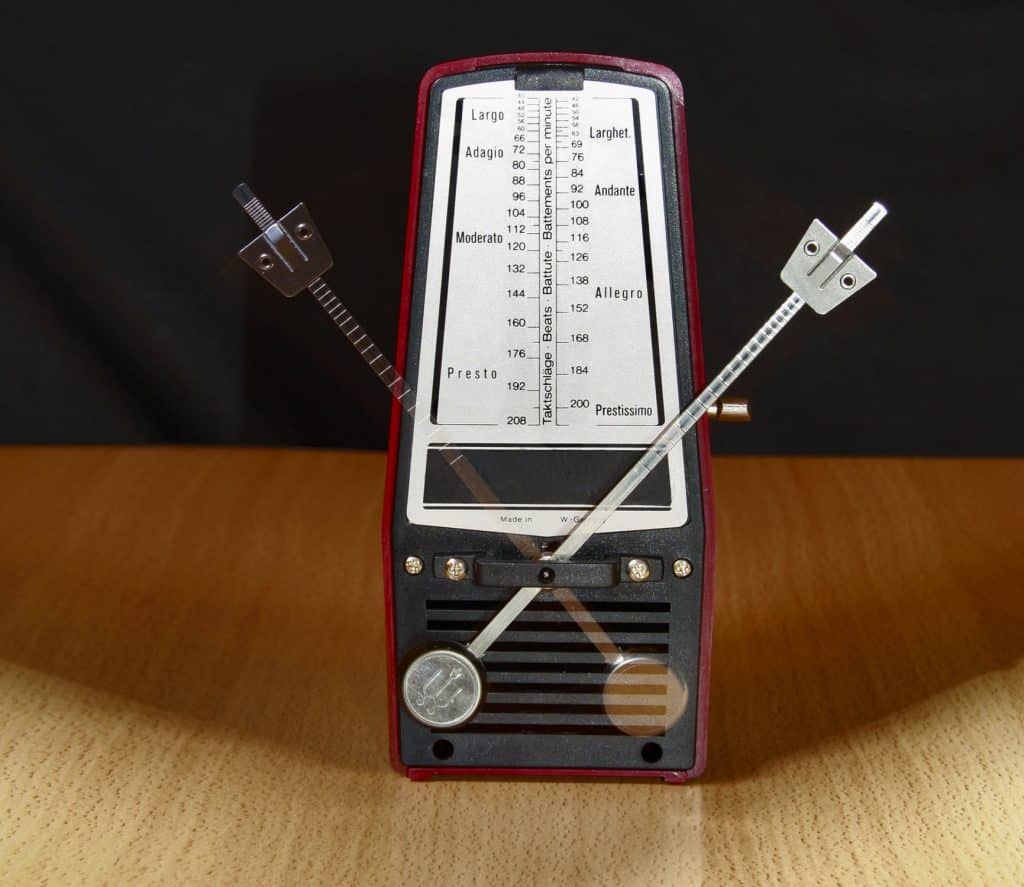
You hear musicians talk most it, only "what exactly is a metronome?". Well, for starters a metronome is a device used by musicians alike to follow a fix stride using ticking sounds. Remember of an erstwhile grandfather clock, y'know, with the pendulum swinging back and forth. It makes ticks just like a metronome, however, it does not change its stride. It's irksome and steady like the period of time itself.
A metronome follows the measure out of time through BPM (Beats Per Minute), and can be set at whatever tempo is desired by the user. The beats per minute one follows ranges anywhere from twoscore beats per minute, to 208 beats per minute. A musician and so uses this "ticking" from the metronome to follow the proper rhythm given by the tempo. Some metronomes give you a steady 4/4 time signature or common time every bit we also call it. Usually these metronomes are constitute online or through software — nosotros'll get more into that later. Your accurate metronome does non measure out a time signature, but simply the tempo.
The purpose of a metronome is to continue a musician in line with the timing of their playing. Information technology gives them the ability to follow a prepare tempo and follow along with whatever song, slice, or exercise that they're trying to play.
Composers usually use a metronome for reference when writing musical compositions.
However, some musicians may non recommend the employ of a metronome at all! The reason behind this, is because metronome time is different from musical fourth dimension.
When nosotros say "metronome time", nosotros talk near the strict beat that goes along with post-obit a metronome — or each tick yous hear. When we mention "musical time", it'south different considering it's more expressive and doesn't always follow the exact beats per minute.
It's quite rare that i should be at perfect timing with the metronome, and in all likelihood, information technology'due south probably meliorate. It makes the music more "human being" and "organic".
When information technology comes to practice…
Musicians will likely turn to a metronome when they are speeding upwards or slowing down at certain parts and would rather stay on time, or a semblance of that every bit nobody's perfect! They'll besides turn to a metronome if they demand to perfect certain techniques, for instance "spider exercises" or "scales". Information technology may as well be a helpful tool in the recording procedure to flex and splice tracks to fit the advisable tempo.
Metronome History
To further understand the metronome, and it's origins we should expect at how information technology came to be.

Sit-in of the pendulum in activeness, using tiny metal balls…
It was back in the late 16th century where the move of the pendulum was being explored by Italian scientist Galileo Galilei. This eventually inspired the thought of the metronome. The way it was experimented was past exploring the different speeds of the pendulum depending on where the weight shifted. Accept a grandfather clock for instance. The motility of the pendulum as it goes back and forth allows it to ability the gears of the clock which allows the hands to turn. Much similar the pendulum of a granddaddy clock, the metronome helps musicians keep track of their timing.
During the 19th century, it was through Deitrich Nikolaus Winkel'south revolutionary research that gifted German language inventor, Johann Maelzel with the standardization and manufacturing of the offset line of patented metronomes named afterward him, "The Maelzel Metronome" or "MM" for brusque. In brusque, he took Winkel's metronome and improved it, making information technology more portable and standardized for all musicians akin.
The metronome markings were used in Ludwig Van Beethovan's music, every bit he sought this as the perfect opportunity to utilize this invention. He used the markings inside his first viii symphonies!
As the years advanced since the former standard metronomes took the spotlight, they have seen many improvements. Some low-cal up, beep even talk! Yous'll find that they're much more easily attainable, and have a wider range of beats per minute to toggle betwixt.
You might say, "well, that's all interesting and such, but why get a metronome? What's in it for me?" Therefore…
Why Get a Metronome?
It is completely optional whether or not yous get a metronome. It is not a must, still it is recommended that you invest in ane. The following are reasons how a metronome may do good your everyday practice:
Firstly, your timing will greatly improve. As long as y'all don't strive for perfection, considering as a wise man once said, "at present that you don't have to be perfect, you can exist good". Another annotation on perfection is, information technology's okay to not have perfect timing, information technology makes the music more "human" and "authentic" and that'due south what people expect for! If you're looking for everything to sound mechanical, and automated, so simply work with MIDI (Musical Musical instrument Digital Interface) and other software to brand the most synchronized piece of music you've ever written.
Secondly, your dexterity will also meliorate. You can challenge yourself with a slow tempo to a much faster tempo by simply adjusting your metronome to do so. The reason yous'd want to do information technology slower, is to make sure that you can play each note on time and on beat. Once comfortable you may adjust the tempo to be slightly faster, and faster. It challenges you to play with the rhythm, because like a ring of musicians, a metronome won't wait on you if you decide to irksome down.
Thirdly, they're easily accessible. You may choose to buy a metronome or yous tin always go digital, with either a program or an app. Both of which are the cheaper option to buying.
Some other reason is that they're extremely mobile. They're so small yous tin can take them just almost anywhere you go! In fact, every bit mentioned before, "then small" they tin fit on your telephone through an app, or through the internet browser on your laptop.
No matter what time signature you're in, you can still do equally long every bit you know what tempo! The metronome does not discriminate any fourth dimension signatures, as information technology doesn't accept an up or downwards crush to it. It but clicks, making it suitable for any vocal, piece or genre of music you're looking to play.
Finally, it will make you a improve player. You'll learn the different tempos to written music, and exist able to play them accordingly. Furthermore, they're great for practicing a set for an upcoming gig. Y'know that part you lot couldn't quite get down, yous can hit the notes, but it sounds sloppy… or you accept the timing, simply non the correct notes… either way, the metronome has you covered!
Types of Metronomes
At that place are a couple of different metronomes you may find, both with the aforementioned purpose and functions. Given your budget and preference, we'll get over which of these may exist right for you!
Analog (Mechanical Metronome)
This was the industry standard for a long time when it came to tracking your timing. It worked without the apply of electricity, and runs from a wind-upwardly mechanism to get it started. Almost of these mechanical metronomes have a fairly wide range of beats per infinitesimal to change betwixt, which can only be adjusted by moving the weight of the pendulum arm up and downward.
When it comes to shopping for a mechanical metronome, yous have the option to buy a more traditional style mechanical metronome, or a smaller more meaty and portable blazon.
Regardless of the type of mechanical metronome you decide to get, brand sure it'southward placed on a level surface so that gravity and the bending isn't messing up the rhythm.
Proficient models to look at are: Wittner 813M, or the much cheaper, Cherub WSM-330.
However, some of you may want something more than, "modernistic" or "avant-garde" which is an okay mode to go too, in fact some people prefer it!
Digital (Electronic Metronomes)
Firstly, it'due south recommended you check out the Boss DB-90 , and the cheaper option, Korg TM50PW .
These "electronic metronomes" frequently perform more the intended purpose, which is keeping yous in fourth dimension with the tempo. Some of them take a vocalism, or electronic beeps to communicate something with you lot. They also typically have built in microphones that can aid you tune your instrument! On meridian of that, they usually go beyond the standard 208 beats per infinitesimal to roughly 250 beats per minute and peradventure higher! There is so much more that they tin practice, but we'll leave information technology at that as that's probably plenty to sway your opinion on its practicality. Information technology'south basically the swiss ground forces knife of every musician out at that place.
Next up…
Other Metronomes
There are then many other options for metronomes out at that place also as things to consider when looking for a fair quality metronome. (These are the more convenient options for those with lack of budget, looking for more practicality, or aren't fix to invest in the real deal just even so.
Firstly, allow'due south talk about the options you have and dive a little deeper into each of them. Equally mentioned, at that place are many options for metronomes, possibly ones you've never actually considered earlier. There are apps, websites, and even software programs that tin do the chore for you lot.
On the topic of apps, there's one easy app that's my go-to simply simply chosen "pro metronome". It does merely that. You can utilize it on your telephone, claw your earphones up to it while playing guitar and developing your timing, adjusting time signatures, irresolute tempo while it names the musical term for said tempo — it is an splendid app and I would highly recommend it! Best of all, it'south free on the app shop for iPhone users. Android users, I'chiliad sure there are excellent alternative options out there if it'southward inaccessible on the Android store. Nonetheless, if not — don't fret over it! The next couple of options are merely as skillful!
Websites can exist just as proficient! In fact if you need just a specific beats per minute (BPM) I'd recommend just simply using Google's metronome. Only blazon in "metronome" into the Google search engine, and "BAM!" you lot accept a metronome. Some other culling is a website I've used for over v years, called Metronome Online. It's an excellent site that has progressed over the years. It not just allows you to adjust your beats per minute (BPM), but tells y'all its musical term! On summit of all of that, it keeps runway of how long you practice! Which is worth noting for futurity reference.
The last recommendation we have here, is software. If you are familiar with any DAW (Digital Audio Workstation) programs out in that location, they will ever have a metronome included inside the software. Regardless of whether you're using Cubase to FL Studio, you're going to be able to keep track of your timing. At that place also happen to be other nifty tools included like tuners, and pitch correctors, but for the sake of this article, we'll stick to the metronome.
Yous may also conform the tempo as you could a normal metronome to new highs, besides every bit modify the time signature and which note gets the beat. Information technology's a very helpful a cost effective way to go a metronome, if..
- a) You already have the software.
or…
- b) You're interested in the recording and song production process, you get some nice perks with the software. (Metronome, tuner, plugins… etc.)
The purpose of these programs including a metronome is for the recording process and making sure you follow the intended tempo of the rails. Which is why 10/10 times you'll e'er see a metronome.
Consensus: If you lot're looking for a cheap alternative, like very cheap and aren't ready to invest no matter the cost, I'd recommend the app, or one of the digital alternatives. However, if yous're looking for practicality, become the "concrete" electronic (digital) metronome. If you're wanting something raw and authentic that doesn't require batteries, go with our mechanical options!
Recommended Metronomes
As written almost in a higher place, when it comes to really buying a metronome for daily usage, information technology tin exist a niggling confusing for virtually. With technology advancing and all of these gadgets built into a metronome and at different prices, what is actually reliable and built to concluding? Typically, the digital metronomes will exist your best bet when it comes to convenience and built to last, all the same, some have different tastes and are more into the actual metronome. Whether or non yous are a tech-savvy person, we'll go through the recommended metronomes and assistance you discover what is right for y'all.
Let's offset with the Analog Metronomes we discussed above…
The Wittner 813M is a pricy metronome for those looking for a finely made metronome, as its casing is congenital from the highest grade hardwoods; matte walnut. Information technology runs only like a typical air current-upwardly analog metronome, producing ticks on each beat out of the adjustable tempo. In fact, a really cool characteristic it has is to allow for "accented beats" of 0, ii, 3, 4, and half-dozen, which sounds a bell as it reaches the beginning beat of a measure out. It can also range from twoscore to 208 beats per minute (BPM).
In curt, it's an splendid metronome if you're in it purely for the fact that you need a metronome and zip else. It does take some handy features, and has splendid German adroitness. Information technology's very recommended if you're not tech savvy, but can appreciate the design and authentic feel.
Adjacent, metronome…
The Cherub WSM-330 is a much cheaper culling to the former discussed. Firstly, it has a beat out by woods cake chip sound, also equally a v position on-off bell. This is typically what helps you count measures. It has the standard tempo range of 40 – 208 beats per infinitesimal (BPM). It has a 1 % tempo tolerance, requires no battery, and has a top-course mechanical mechanism.
In short, it would be an ideal metronome for those looking for something cheap, but authentic with great functionality. Information technology's an caused taste for most as it produces a somewhat irritating audio, however, information technology works well for what you pay. It's definitely for those on a budget, non tech-savvy, and are looking for an authentic metronome they may want to place on their stand, piano, or generally anywhere apartment surfaced.
Let's talk about some Digital Metronomes…
Firstly, the Dominate DB-ninety is a pricey however an amazing metronome for those who are looking for something digital and superlative of the line. It is the well-nigh advanced metronome available. It has a congenital-in rhythm bus to help you blast down your timing, built in MIDI (musical musical instrument digital interface) for those looking to implement a pulsate machine fashion blueprint to a set up tempo. On top of that it can help you track pitches and proper name the note, tune your instrument, wider range of beats per minute, higher and lower than the standard… and more than!
In short, definitely a neat metronome for those looking for more than than but a metronome's functionality merely a sort of "swiss army pocketknife" solution to all their musical needs. It is pricey, but comes with more than you bargained for when shopping for a metronome, which justifies the price for the most office. Furthermore, information technology does run on batteries, every bit opposed to the analog air current up functionality, still the electronic aspect of information technology gives yous enough more than options in ways to utilise information technology. Information technology'south similar a smart device in metronome form.
At present the cheaper alternative…
The Korg TM50PW is a much cheaper option in the digital metronome department. For starters, it has a congenital in tuner which can exist used at the same time as the metronome. A highly responsive needle-type meter is included for your tuning needs. It can notice a very wide range of octaves from C1 to C9, and ranges from 30 – 252 beats per infinitesimal (BPM). On acme of that information technology has sixteen built in rhythms that allow you to do a very wide range of musical styles.
In short, it's very recommended if you have a very small budget, just need something that can simply almost do information technology all and more. You definitely get more than yous bargained for with this metronome. Furthermore, it'south small and compact, and a very resourceful device. It'due south definitely for those who are tech-savvy and bask devices with multiple functions for a cheap and fair price. It should be bought with a case though to prevent whatsoever impairment, as it is delicate.
How to Utilise a Metronome In Practice
So, you finally got your metronome and y'all're gear up to practise! You lot feel stoked, but wait… "What do I actually practice to brand the well-nigh apply out of this new metronome?" — don't worry! In fact, many of the states know what nosotros want musically, but don't exactly know how to become there! We got you covered as you read on, then you can feel confident in your everyday do with your brand new metronome! Here is how to use a metronome.
First things first, y'all're definitely going to want to develop your finger dexterity. In fact using "spider exercises" are something I wish I knew about when I had outset started out learning how to employ a metronome. I would take been much further along if I had practiced these finger dexterity exercises and mastered how to use a metronome earlier.
Spider Exercises
There are a number of unlike spider exercises you may use to develop your finger dexterity, some far more difficult than others, just will develop and improve your musculus memory, finger forcefulness, and finger accuracy when playing with both hands simultaneously.
The first exercise we should go over is the 1-2-3-four spider exercise. The reason it's called the 1-2-three-4 finger exercise is because of the fact that each of these numbers represents the numbered fret on the cord. The 1st fret, second fret, tertiary fret and the 4th fret.
What to practise :
- You want to beginning on the low E string, the string that sounds the lowest in pitch opposite of the high E cord.
- Next, you'll want to prepare your metronome to… let'due south say eighty beats per infinitesimal (BPM), should be ho-hum enough! If information technology's likewise fast, endeavor lx beats per minute (BPM) as yous get used to how to utilise a metronome
- Then while listening to each tick of the metronome, you lot'll desire to play the 1st fret with your index finger, then the 2nd fret with your middle finger, the third fret with your ring finger, and lastly, the 4th fret with your pinky finger.
(Endeavour that on merely the depression E string most 10 times to get a feel for it…)
Note: If y'all're finger picking, use your thumb on the low E cord. If y'all're using a pick, then recollect to down-up pick between each annotation.
Got it? OK!
- Play the ane-2-3-4 on the low E again.
- When yous finish on the 4th fret of the low E, move your style upwards to the A string! Literally the cord adjacent to the low E.
- Play the ane-2-3-4 on the A string with appropriate fingering every bit before!
- Later you've hit the 4th fret, move to the next string… the D string.
- Do the i-ii-3-4 exercise again on the D cord, and so move to the G string.
- Repeat the 1-2-3-iv exercises on the G cord over again and so motility to the B cord.
- Exercise the i-two-3-4 exercises on the B cord, and so movement to the high East cord and exercise information technology at that place too!
OK, you're officially halfway done your showtime set! Good work!
At present we go back downwardly…
Instead of playing 1-two-iii-iv, on each string, we'll be playing four-iii-2-1 from the loftier East cord to the low E string. Like and so…
- Play the frets four-three-2-1 on the high E string.
- When you finish on the 1st fret of the high E cord, motion back to the B cord and play iv-3-two-ane.
- When yous finish on the 1st fret of the B string, move back to the Thousand cord and play 4-3-2-1.
- When you lot end on the 1st fret of the Grand string, move dorsum to the D string and play 4-three-2-1.
- When you lot cease on the 1st fret of the D string, move back to the A string and play 4-3-2-1.
- Finally, when you end on the 1st fret of the A cord, move back to the low E string and play 4-3-2-1.
Yous've officially completed 1 set! Congratulations! Do this at least 10 times without messing upwardly earlier moving on to the adjacent set of instructions.
Y'all've made it! Now to offset the 2nd prepare. Instead of playing the ane-2-three-4 do going upward, nosotros're going to play the 2-3-4-5 exercise. It's pretty self-explanatory, only we'll just become through it one more fourth dimension for you guys!
- Start on the depression Eastward cord over again and play the 2nd fret, 3rd fret, 4th fret and 5th fret.
- Once yous hit the 5th fret of the E string, move up to the A string and play the 2d fret, 3rd fret, 4th fret, and fifth fret.
- Once y'all striking the 5th fret of the A string, move up to the D string and play the 2nd fret, 3rd fret, 4th fret, and 5th fret.
- Once you striking the 5th fret of the D cord, move up to the Yard string and play the 2d fret, 3rd fret, quaternary fret, and 5th fret.
- Once you hit the 5th fret of the Grand cord, move up to the B string and play the 2nd fret, 3rd fret, 4th fret and 5th fret.
- Finally, once you hit the 5th fret of the B string, move up to the high Eastward string and play the 2nd fret, 3rd fret, 4th fret, and 5th fret.
So, go dorsum down!
To sum information technology upwardly, you lot basically play 5-4-3-2 from the high E string all the way downward to the low E cord, and so after hitting the 2nd fret, you modulate your exercise past one fret higher; becoming 3,four,five,6 upwards and 6,5,4,3 downwards… and so on! All the manner until you finally attain the 12th fret.
As you master how to use a metronome, if you can play this practise all the style until the 12th fret at least 10 times without messing up, you're prepare to increase the tempo.
However, to make it easier for those of you lot who would rather see what yous're doing to become a ameliorate understanding of how to employ a metronome, wait below as it'south laid out in tablature for y'all to see:


If you experience that either:
- This exercise is becoming likewise easy for you.
Or…
- b) This exercise is condign slightly boring.
You're welcome to alter it upwards every bit y'all master how to use a metronome! Because the most important thing for you every bit a musician is that you keep your practise interesting and challenging. You tin either increase the tempo, or play double fourth dimension. Playing 2 notes per tick on metronome.
If that's non quite the change you lot're looking for, then try out one of these many unlike combinations of the spider exercise:

You lot're likewise more able to modify these practices to make them far more than challenging to greatly ameliorate your finger dexterity and challenge yourself with odd patterns.
Accept the i-two-three-4 exercises for instance! They're pretty easy to selection up for the almost part, right? But what happens when we modify which strings the notes are beingness played on — and even have them alternate?
We get something like what nosotros run across below! Give that a shot!


If you lot're looking for something different, you lot can also endeavour these patterns!


This should most definitely spice upwards your finger exercises on guitar every bit yous master how to use a metronome, and even better improve any sloppiness in your playing!
What's fifty-fifty better is that whatever of these patterns shown can easily be inverse by using the 1-2-3-4 nautical chart above. You lot tin can always play the patterns using 2-3-ane-4 or fifty-fifty by using iv-two-1-3. And so many possibilities!
Utilizing these practices in your everyday guitar practise, you'll be certain to detect and huge divergence in your technique!
Playing Without a Metronome
Don't want to use a metronome? You tin can also develop your ain inner clock, or utilize a "torso rhythm" to feel the groove of the song.

Musicians exercise not e'er apply a metronome. They tin can besides rely on their sense of sound and rhythm.
Musicians usually develop an ear for pitch and tone on their ain clock — some develop information technology within weeks, months, even years! The same generally goes for understanding rhythm and timing. You develop a sense of, "something sounds off…" or maybe, "the timing is impeccable". It all comes from experience and y'all developing every bit a musician. If you lot're but starting out, don't expect it to come right away, however, it can be exercised through, playing, listening, and practicing!
Metronomes didn't always exist, and music has been around even since 1500 BC in the prehistoric era, so the question arises — how does i play without a metronome? Or ameliorate… How does ane develop a sense of timing?
Let's first talk about the good of a metronome for beginners. Information technology won't hinder you to acquire timing from a metronome. If yous accept this sort of stigma well-nigh a metronome, y'all need to put that behind you and sympathize the pros as well equally the cons! Practicing using a metronome can in fact if used correctly, help you develop a ameliorate sense. In fact, y'all can slow the tempo of each tick to beat to the offset of each bar instead of every trounce. From at that place y'all can then cutting it out and play with just the sheer sense of knowing the rhythm yourself, because you lot can feel information technology!
That being said…
The best manner you tin first playing without the use of a metronome, firstly, is to focus on your counting in whatsoever time signature yous're playing at a slow and comfortable rhythm. So for instance, if you're playing in iv/four time which we also call common time, we would commencement by either simply tapping our human foot, clapping, or tapping our hand on our lap to a steady tempo, whatever tempo you can muster slowly, and to a ane-2-3-four, 1-two-iii-4, ane-2-3-4 rhythmic pattern…
Play the tempo's rhythm for sixteen bars merely to get a feel for information technology.
One time you've gotten the hang of it, try and play something with elementary rhythms that are on beat. Songs like "Ode To Joy", "Mary Had a Little Lamb" or "Twinkle Twinkle Little Star" are keen starting places for beginners!
If you're looking to improve your timing at a difficult slice you may either endeavor:
- Learning to take the preparation wheels off, too known equally; easing yourself off the metronome if yous are an avid user of 1. This can be done by slowing the tempo, and play double or quadruple time. When increasing the time of your playing just slowing the metronome's tempo, we are actually simulating what it's similar to accept minimal guidance. In other words, the metronome will beat at the offset of every bar. Eventually can be inverse to beat every 2 bars and and then on…
- Maybe, you don't have the money for a metronome, or you lot don't believe in using them; sight reading will be your all-time friend in this scenario. Let'due south say that we're using common fourth dimension (4/iv), and we have an assortment of quarter notes filling up the bar, you lot already know that each quarter note gets the beat out, and that in that location are 4 of them in each bar. But, tap your foot and give yourself 2 bars of introduction, and so on each vanquish: clap, clap, clap, clap. That's it!
You may endeavor different variations of rhythms, where they might get more challenging and use different time signatures. This is how you develop your ear, and your sense of timing.
- The terminal option is to listen! If yous have a metronome, practice getting used to unlike tempos. It also helps to associate these tempos with their musical names. Adagio, Grave, Presto… etc. Tap your foot, or handclapping your hands to these beats. Really try to drill it in, practice option b) with information technology and sight read while tapping your foot to the tempo. If you lot don't have a metronome and want to work on timing, listen to music at varied tempos and clap forth to the tune. Some examples are:
Nothing Else Matters – Metallica (46 beats per minute)
Perfect – Ed Sheeran (63 beats per minute)
Bohemian Rhapsody – Queen (72 beats per minute)
Wonderwall – Haven (87 beats per minute)
Blackbird – Beatles (93 beats per minute)
Highway To Hell – ACDC (112 beats per minute)
Rockin' in the Free World – Neil Young (131 beats per minute)
Crazy Little Thing Called Love – Queen (152 beats per infinitesimal)
Schism – Tool (167 beats per minute)
Master of Puppets – Metallica (220 beats per minute)
Clapping along to any of these songs at their tempo should prove more than enough challenge for whatsoever musician out in that location. With their wide range of tempos, you should become a existent feel for the spectrum of dissimilar beats per minute they adhere to.
Furthermore, if you're interested in picking up your guitar, looking up the tablature and playing along to these songs, you'll gain an equally benign feel if not more than simply clapping along. Master these different tempos, and you lot should be able to play in fourth dimension to any vocal using your own inner metronome.
Moving Forwards
So at present, y'all've made it to the cease of the article and have a pretty skilful understanding of non just the origins of the metronome, merely how information technology works and to use information technology to the best of your ability. We'll cover a few things of use for going forward and then that you don't feel lost in your practice and stuck in a "musician'south rut", so that every practice is more than productive than the last!

A winding path leading to the unknown, a metaphor for the musician'southward journey
So, you want to brand the most of each and every exercise with your metronome, correct? Firstly, this will go forward with the assumption that given the fact that you've read this far means you lot are a dedicated musician that wants to get better, or play with their band as a tighter knit group. For casual musicians, it'due south okay to go on reading, however, you might find some aspects a little extreme, in which case, to your flexibility, you lot may tone it downwards to your liking.
Assuming the article finished here, you're sitting in your exercise infinite with a bare look, "this was useful, only what practise I exercise now?"
Firstly, it'due south recommended you begin with some finger exercises to develop your finger dexterity, strength and synchronization with your other manus. If you're a beginner that wants to develop fast, effort not to arrive that mindset… only play for the sheer enjoyment of music, and you'll get at that place! Time flies when you're having fun!
Beginners should outset at about xl BPM, while intermediate players should start at 60 BPM.
Earlier we discussed using spider exercises, we have several variations of them hither, nonetheless, if you want more, in that location are other places yous tin can detect them online with a simple Google search, "spider exercises for guitarists".
Once yous observe the spider practice you wish to do, let'south say information technology's the standard ane-2-three-4 exercise where you gradually move up each string and then come back down. Play it to that tempo given to you lot whether you are a beginner or intermediate guitarist.
You should play it on each tick of the metronome going up the cervix, one-2-3-iv, next string, 1-two-3-four, next string, ane-2-3-4… and so on before coming back down and doing 4-3-2-1 on each string.
Timing is a must. Accurateness is also a must. If at whatever point yous observe yourself off timing, or your finger hits the incorrect note, or just not difficult plenty… restart. This isn't some sort of torture or punishment, although at the start it might feel as though it is, it is to hardwire muscle retention and build your finger dexterity up. If you lot let skid ups to slide by, and then you're only giving yourself permission to play sloppily and thus you won't get any better.
"Why and so deadening though?"
Speed isn't impressive unless you hitting all the correct notes on time. Everyone can play fast, but can everybody play with 100% accurateness? That's what separates most serious musicians, from the coincidental musicians.
We start off slowly, because we desire to hit the right notes. It doesn't matter how fast you do it, information technology matters how accurately you do it. Actually effort and drill that in, considering that's where most musicians mess up.
Challenge:
Try and play all the style upwards to the twelfth fret 10 times without messing upward. If y'all tin can do that, then you might just be prepare to shift the tempo upward some other 4 BPM. And then do information technology over again. If you pull that off, bring it upward another iv BPM equally you use the metronome…
At present, that may be too easy for some of you, and that'south okay. That's when we perform the aforementioned exercise but in double time as you use the metronome. What is meant by double time is past playing each annotation twice as fast. So between each tick of the metronome, you'll want to play two notes.
Something like: 1-two.. *tick* 3-four.. *tick* one-2.. *tick* 3-4.. *tick* 1-2.. *tick* 3-4.. *tick*
It was hard to prove, but the 2nd and 4th notes will exist on the tick, while the 1st and tertiary notes volition be in between.
This is unlike than earlier because each note was on the tick.
Even harder: You may play in quadruple time, and that'southward like:
1-two-iii-4.. *tick* 1-2-3-4.. *tick* 1-2-three-iv.. *tick*
Each 4th annotation is on the tick, while the 1-2-3 is in betwixt.
It'due south a pretty useful exercise for all musicians alike to be able to play different patterns and at a variation of different tempos! Scales may also be used with a metronome if you tin can suspension down the calibration to what yous'll play betwixt each tick. This will help yous understand scales better and which notes are associated with which, and can be used in solos, licks, or improvisations.
The next useful thing you lot should practice is how to use a metronome to develop your inner metronome.
This is something that both metronome users, and non-metronome users can both benefit from, despite their different views and beliefs on this practical tool. As mentioned before, yous may play along with whatever of those songs at that tempo, which will give yous a good feel for songs at a variation of different tempos. Which is good if you don't want to use a metronome.
Those songs should be practiced religiously, if you lot're looking to memorize a certain tempo.
However, if you utilise a metronome, yet you don't want to depend on it, and then definitely do the following:
Take a piece of sheet music, it doesn't affair if it'due south written for guitar, pianoforte, vocals, whathaveyou. It'd also help if you've never heard this music before, to await it up on YouTube. Information technology'south practiced to have that sort of guidance to empathise the rhythm and how the song is structured. If you desire, you lot may fifty-fifty go in blind, await it up after and run into how close you got.
Next, try clapping out these rhythms. You lot may offset observe the tempo of the written slice of sail music, plough your metronome on and tap your foot to it. After a good 8 bars of tapping your foot, turn it off but go on your foot tapping, then clap out the rhythms written on the canvas music. This will help you lot hardwire and keep the rhythm in your body as opposed to using simply your ears to follow the rhythm because rhythm needs to be felt!
Y'all may attempt this with any song, or written piece of music out there. It's an splendid practice and should exist washed over and again until the tempo becomes second-nature.
These exercises should be practiced religiously as they will greatly benefit and develop you equally a musician.
There you lot have it! Some guidance towards what to do after yous're washed reading this article. Being a musician and feeling lost towards your craft is an awful feeling to have, so knowing the steps to take in social club to improve yourself and your playing are definitely useful in giving yourself direction and taking your playing to the next level. Remember, keep practicing, don't get discouraged, and make it meaningful everyday. Always enquire, "what am I trying to attain from today's practice", rather than going about it meaninglessly, go near it methodically.
Keep on playing and learn how to utilise a metronome for the dearest of music! Keep rockin'!
Source: https://beginnerguitarhq.com/metronome/
0 Response to "Say It Over and Over Again Bpm"
Post a Comment